
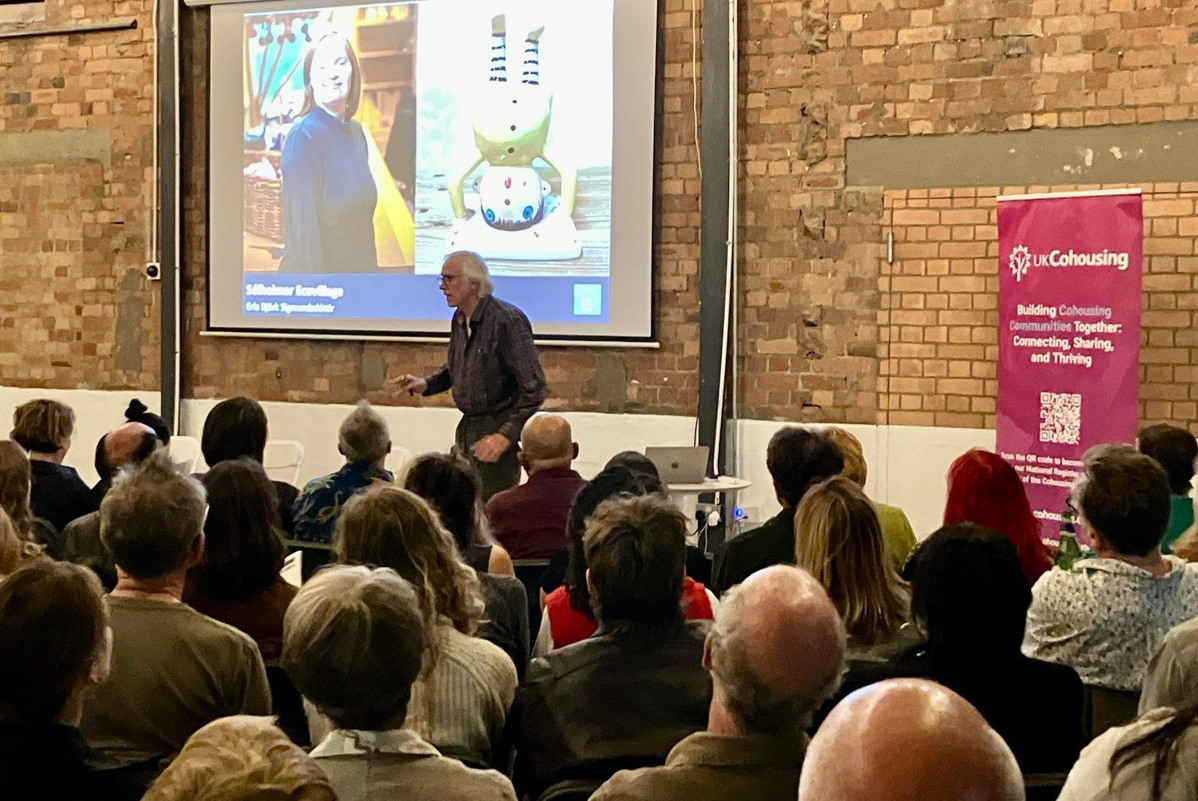
UK COHOUSING NETWORK · TOUR REPORT
Building the Neighbourhoods We Need
Chuck Durrett’s UK Cohousing Tour
By Owen Jarvis
North, south, east, west: four cities, two community visits, one fireside chat and packed rooms everywhere. Cohousing pioneer Chuck Durrett’s UK tour showed how much energy there is for a better way to build neighbourhoods.
At the end of September, the UK Cohousing Network welcomed Charles “Chuck” Durrett back to the UK. He is the architect who brought cohousing from Denmark to the United States, and over four decades he has helped design more than 55 cohousing communities. Chuck returned, possibly for the last time, with a new book and a clear message: as the UK movement enters a period of growth, it must not lose sight of the core values at the heart of cohousing.
The moment is right. Chuck first came to talk about cohousing in the UK in 2005, when the movement was just fledgling, and a lot has happened in the 20 years since. Today there are 25 established cohousing communities in the UK offering inspiration, 12 more in the pipeline to open in the next few years, and more than 3,000 people on the national waiting list. Cohousing, alongside co-operatives and community land trusts, is now actively supported by the housing minister, who has instructed Homes England to prioritise funding for community-led housing.
THE TOUR
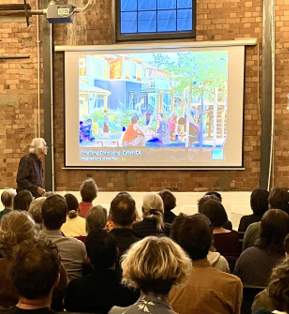
Building the Neighbourhoods We Need opened with visits to New Ground and Lancaster Cohousing. It then ran public events in Manchester (28 September), Oxford (29 September), Bristol (30 September) and London (1 October). It closed with a fireside chat and dinner at Marmalade Lane in Cambridge.
Every event was built with local partners. Each drew a full room of housing professionals, councillors, architects, developers, residents and people simply curious about living differently. The message was clear: people want neighbourhoods that are friendlier, healthier and more connected, and cohousing shows how to build them.
“People want neighbourhoods that are friendlier, healthier and more connected.”
Where it began: New Ground and Lancaster Cohousing
Before a single slide was shown, Chuck went to see UK cohousing as residents live it.
At New Ground in High Barnet, home of the Older Women’s Co-Housing group, he saw what years of patient, resident-led effort can produce. New Ground came up again and again later in the tour. Its balconies over the shared garden have become what one architect called a “three-dimensional living room”, where neighbours can chat, retreat or simply watch the world go by.
At Lancaster Cohousing, beside the River Lune, he walked the pedestrian street and shared spaces of one of the UK’s best-known eco-communities. It was a chance to compare notes with residents who have made cohousing work for more than a decade.
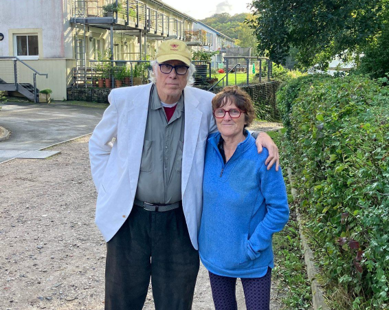
“A three-dimensional living room.”
— How one architect described the balconies at New Ground
These visits grounded the whole tour. When Chuck spoke about design that brings neighbours together without taking away their privacy, he could point to British examples that already prove it.
Four cities, four full rooms
Each evening was unique, whilst following the same shape. Chuck gave a keynote drawn from hundreds of communities worldwide. Then a local panel of specialists and residents brought the conversation home to their own city.
MANCHESTER, 28 SEPTEMBER
The tour opened in Manchester with Greater Manchester Community Led Housing. The audience left inspired and ready to act. As one attendee put it: “Charles has so much cohousing knowledge and experience and I think we all felt inspired and motivated by his speech.”
The energy did not stop at the door. Greater Manchester Community Led Housing’s November Forum will follow up on the actions committed to on the night, to push for cohousing across the city-region.
OXFORD, 29 SEPTEMBER
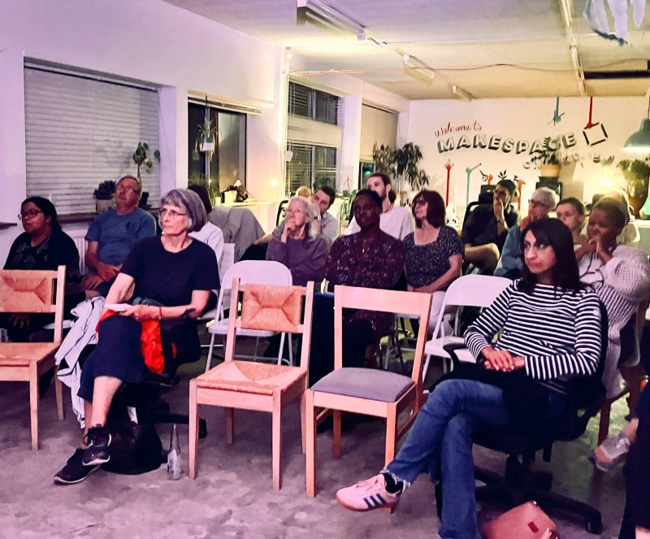
In Oxford, Transition by Design and Oxford Cohousing hosted a warm, packed evening at Makespace. Transition by Design’s Wongani Mwanza joined the panel, and the room was full of people asking how cohousing could work in one of England’s least affordable cities.
BRISTOL, 30 SEPTEMBER
Bristol’s event at the Paintworks, with Barefoot Architects, doubled as a celebration of the practice’s tenth anniversary. Chuck spoke to a packed room before the panel turned to the South West.
Our panel included Sam Goss, Founder, Barefoot Architects; Judith Griffies, Bridport Cohousing CLT; and Caroline Pringle, Ecomotive.
One attendee, Ann Haskins, summed up a thread that ran through the night. Cohousing feels new, but it is rooted in something very old: “It takes a village to raise a child.” The difference now, she wrote, is that “we can no longer take that village for granted. If we want strong communities, we have to design for them, organise around them and intentionally create them.”
“I’m now keen to read more from Charles and understand what a practical UK cohousing playbook could look like, making the hard-won lessons from successful communities easier for others to follow. The Bristol conversation also asked hard questions. How do we scale cohousing faster? How can the wider housing sector borrow its shared spaces and resident stewardship? And how can the movement learn from social housing to widen diversity and access?”
— Joe Goss, after the Bristol event
LONDON, 1 OCTOBER
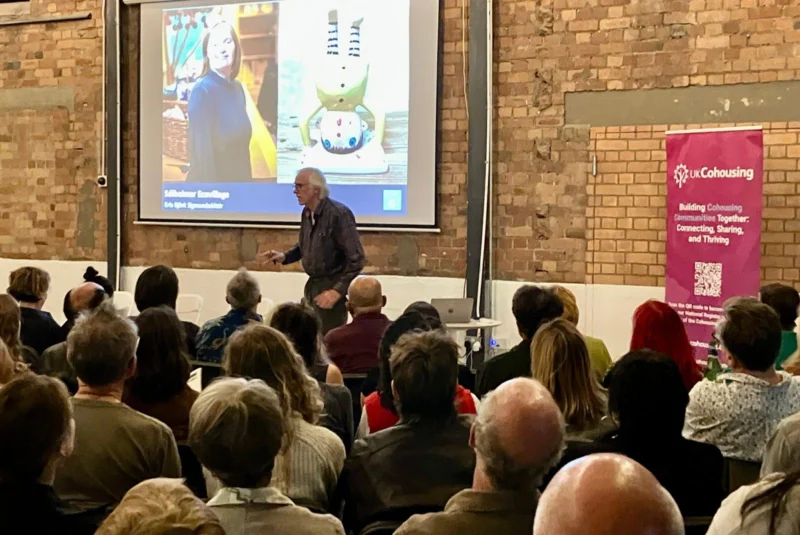
The tour’s final public event was hosted by Pollard Thomas Edwards in London. Housing professionals, policymakers, developers, architects, community leaders and residents asked one central question: how can cohousing move beyond a handful of pioneering projects and become an established part of housing delivery?
Architect and writer Harriet Saddington chaired a strong panel:
- Charles Taylor, Aspen Retirement, described a hybrid model where the developer carries the risk and residents take over the freehold. He called cohousing for older people “the best-kept secret”: “There’s a whole load of people out there who are ageing in inappropriate homes that aren’t suited and fit for purpose. The market’s not responding to their needs.” In the US, he noted, 70–75% of cohousing homes are sold before they are built.
- Monique Wallace, Lewisham Council, set out how councils can help groups through planning and land. “If we help you deliver this type of housing, we’re helping ourselves.” With around 2,500 families in temporary accommodation in Lewisham, she urged groups to show what housing need a scheme meets, whether it can free up under-occupied homes and how it makes use of constrained sites. Lewisham is now developing a community-led housing strategy.
- Elanor Warwick, Clarion, urged all housing providers to design in the “bump spaces” where neighbours meet, “as standard”. A communal room alone does not create community: routes, decks, gardens, entrances and even recycling areas can all become social infrastructure.
- Anurag Verma, Rural Urban Synthesis Society, the community land trust behind Church Grove in Lewisham, spoke about “ownership for the common good”. RUSS won the land through a public tender and delivered 36 homes for around £13m, backed by a wider community of more than 1,300 members. “If you give people agency, they will generally not disappoint.”
- Patrick Devlin, Pollard Thomas Edwards, drew together four design lessons: shared space, good daylight without overheating, contact with nature, and a sense of ownership that goes beyond the title deed. Using New Ground, he showed that “living as a community depends on people having secure private spaces”.
“If you give people agency, they will generally not disappoint.”
— Anurag Verma, RUSS
The discussion kept returning to scale. Access to land, finance, planning, organisational capacity and the sheer length of the development process remain the biggest barriers. But panellists argued that resident participation can help de-risk projects, by building local support and creating committed advocates for a scheme. Evidence will matter too: measuring how homes perform once people move in, from energy ratings to health benefits, can make the case for why public funding should back cohousing.
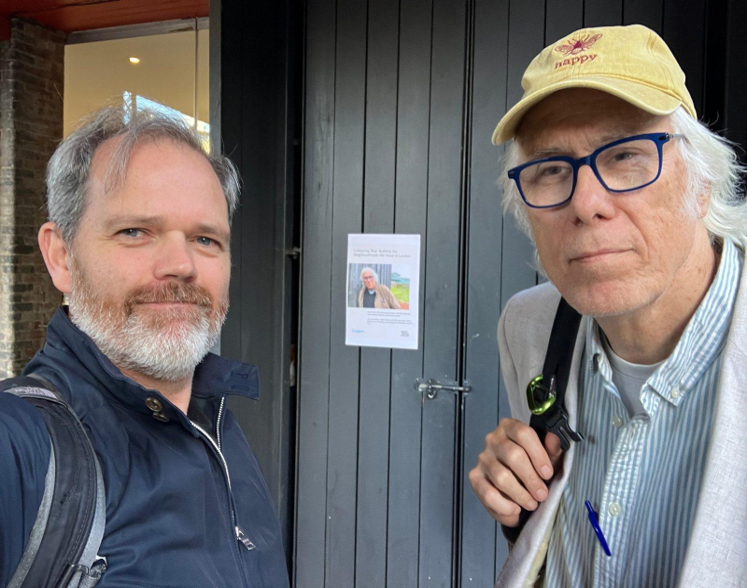
Pollard Thomas Edwards has published a full write-up of the London evening.
A fireside finale at Marmalade Lane
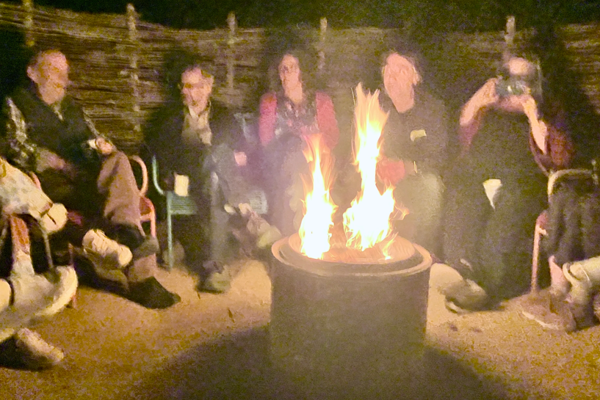
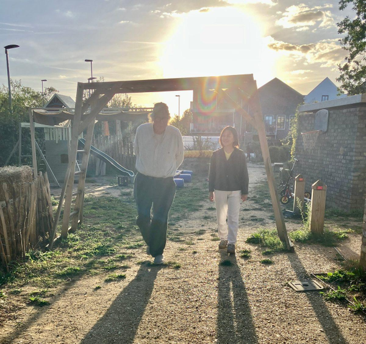
The tour ended where cohousing does its best work: around a shared table. At Marmalade Lane in Cambridge, residents hosted Chuck for a fireside chat and a community dinner.
It was a fitting close. Chuck often says that eating together is the heartbeat of a cohousing community. Here, after four big public events, the conversation became personal: what it is really like to live this way, day to day, once the excitement of moving in has faded. As Chuck puts it, good architecture is what keeps a community going once the honeymoon has worn off.
“If it doesn’t work socially, why bother?”
— Chuck Durrett
What we heard: the principles behind cohousing
Across every stop, Chuck came back to a handful of core ideas. Together they explain why cohousing works, and what the wider housing world can learn from it. In Chuck’s words, cohousing is about “reconstructing what used to happen naturally”: consciously creating the village that, as Ann Haskins put it, we can no longer take for granted.
1 Start with the life you want, not the building.
Every project begins with three questions: Who are we as a culture? Who do we want to become? How do we get there? Goals come first, then activities, then places. “If it doesn’t work socially, why bother?” Chuck calls this problem seeking: don’t solve the problem until you know what the problem is.
2 Residents must own it emotionally.
Participation is not a consultation exercise. “It’s not just their input and their data that I need. I need them to own it emotionally.” That ownership carries a group through planning, finance and construction. “We built it, not brick by brick, but decision by decision.” People worry the process will go on forever, but the core participatory design work takes place over two days. And as Chuck asks, do planners, developers and investors really know better than you how you want to live? “Everyone has a little architect inside them.”
3 Design for spontaneous socialising.
The position of the common house, the width of a path, a front porch, the view from the kitchen sink: small choices create everyday chances to meet. As Chuck put it, our cities have successfully designed community out. Cohousing designs it back in. Even the recycling point matters: put it on the street and it brings eyes on the street, making the place safer. And when the beer club opens a new keg at the barbecue, nobody needs to send an email. Everyone just shows up.
4 Privacy is the foundation of community.
“Have as much community as I want, or as much privacy as I want.” People should see what is happening in shared space without feeling obliged to join in.
5 Eat together.
Shared meals in a well-used common house are the heart of a high-functioning neighbourhood. Breaking bread is an ancient form of community building that still works today. Food, fun and friendship. A simple test of success: a working common house is used for an hour or more every day, because activity attracts activity.
6 Decide together, and learn how.
Well-facilitated consensus is not about who is right. “Basic cohousing maths is one plus one equals three.” Two ideas, talked through, make a better third. People are often afraid of consensus when it isn’t well facilitated, so Chuck recommends learning the skills, such as Non-Violent Communication. The aim is not to decide who is right, but to find the best solution.
7 Cohousing is good for every age.
Chuck shared the mission of one senior group: to have as much fun in the second fifty years as the first. Intergenerational communities bring together people who might never otherwise meet. Much of the care neighbours give each other is casual: mostly, people just want company. In Copenhagen, when 80,000 seniors were asked to choose where they wanted to grow old, the majority chose cohousing.
8 Cohousing can cost less to live in.
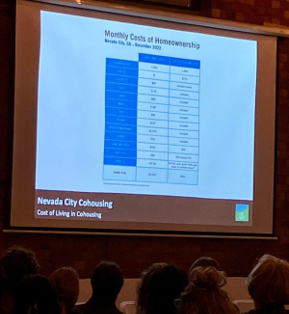
A Nevada City case study showed shared facilities such as a hot tub, pool, guest rooms, gardens and a common house folded into one monthly cost, well below that of a typical single-family home.
9 Scale up by building great models.
There is no shortcut. “How do we scale up? I would argue it’s one step at a time, very deliberately. Build great models.” And: “Build the first one perfectly so you can take a thousand photographs of it and say: honestly, this worked. Let’s do that again.”
“Build the first one perfectly so you can take a thousand photographs of it and say: honestly, this worked. Let’s do that again.”
— Chuck Durrett
Want to go deeper? For architects, Chuck recommends his book Cohousing Communities, written because too many US projects failed: design can make the difference between a community succeeding and failing. He also recommends Habits of the Heart by Robert Bellah and colleagues, on connection and belonging.
Thank you to our partners
This tour happened because local partners opened their doors, filled their rooms and shaped each conversation. Our warmest thanks to:
| City | Partner |
| Manchester | Greater Manchester Community Led Housing |
| Oxford | Transition by Design and Oxford Cohousing |
| Bristol | Barefoot Architects, celebrating ten years |
| London | Pollard Thomas Edwards |
| Cambridge | The residents of Marmalade Lane |
Thank you too to the residents of New Ground and Lancaster Cohousing for their welcome, to every panellist who gave their time, and to everyone who came along. Above all, thank you to Chuck Durrett for bringing four decades of experience, and so much generosity, to the UK.
What happens next
The tour raised awareness and energy. Now the work is to turn it into homes. Here is how you can be part of it:
- Join the national register. Add your name to the more than 3,000 people waiting for a cohousing home, so we can show the demand to councils, funders and developers.
- Find or start a group. Groups at every stage are forming across the UK, and we can help you connect with peers and tools.
- In Greater Manchester? Look out for the November Forum, following up on the actions committed to at the Manchester event.
- Bring the principles into your work. Architects, planners, councils and housing providers can design in shared spaces and resident participation, whatever the model.