
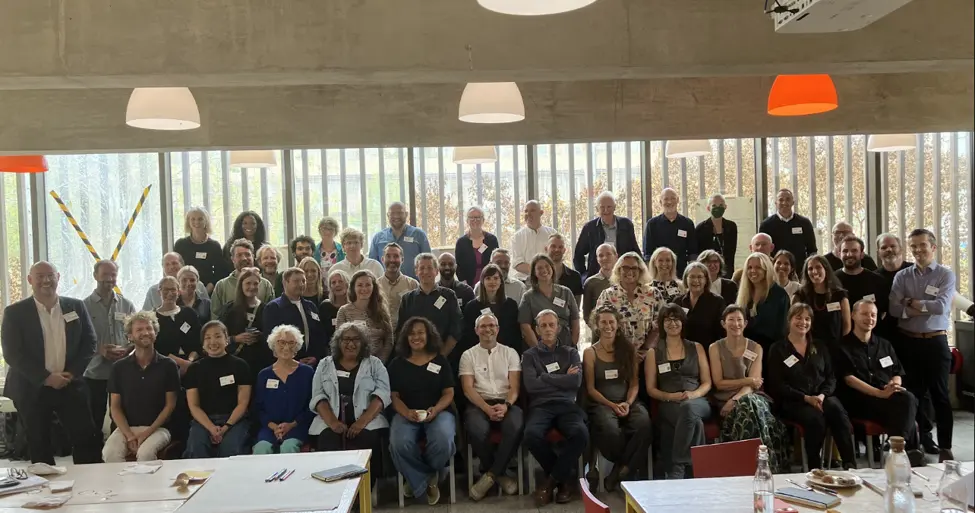
This report draws together the flipchart notes, discussion outputs and slide framing from the Community-Led Housing Futures summit, held on 15 September 2026 and convened by UK Cohousing Network with Sheffield Hallam University, the University of Bristol, the University of Leeds, the University of Liverpool and the Nationwide Foundation as initial stewards. It is intended as a working record for the co-founders’ meeting on Friday, and as a summary to share with all attendees.
1. About the Summit
Community-led housing (CLH) is at a crossroads. Many believe it has the potential to become a fourth pillar of housing supply, alongside the private, public and charitable sectors. Communities across the UK are demonstrating new ways of creating homes that are more affordable, resilient, sustainable and connected, and interest is growing from government, housing associations, investors and local authorities. The Housing Minister Matthew Pennycook has instructed Homes England to prioritise funds to community led housing and backed the call to see CLH strongly present in New Town Delivery. Partners in Scotland and Wales are also raising the profile and policy base for CLH significantly.
Despite successful projects, growing demand and increasing recognition, the sector has not yet fulfilled its potential. The summit was framed around three questions:
- What is holding the sector back?
- What evidence is missing?
- What knowledge and partnerships are needed to unlock the next stage of development?
Rather than presenting research papers, the day marked the start of a new conversation about how research can better support the movement — identifying the questions that matter most, highlighting the evidence needed to influence policy and practice, and beginning to develop collaborative, fundable research propositions. The afternoon looked beyond individual projects to the lasting infrastructure needed to support this work: an ongoing research network, collaborative funding bids, future events and, potentially, a dedicated Community-Led Housing Research Centre.
The event was a participative summit rather than a traditional conference, bringing together four groups in the room throughout: CLH practitioners, government and policymakers, investors and industry, and academics/researchers (who moved between tables to facilitate and listen).
2.Executive Summary: Cross-Cutting Themes
A small number of themes recurred across almost every session and exercise of the day, regardless of which sector was speaking. These are the threads most worth carrying into the co-founders’ meeting:
Most strongly corroborated themes
A handful of points weren’t just raised once — they surfaced independently, in different words, on three or more separate flipcharts, worked by different tables who couldn’t see each other’s notes. Where a theme is repeated like this without prompting, it’s a reasonable signal of genuine weight across the room, rather than one table’s individual preoccupation. The clearest examples:
- The need to “demystify” CLH — described as too “weird”, “niche” or misunderstood — came up independently on at least three separate fears/hopes sheets.
- The ambition to match Housing Association-style delivery volumes (c. 20,000 homes/year) as a benchmark for what CLH could achieve appeared on two separate sheets, unprompted.
- Audience – who is the research for, what difference can they make and what evidence do they require – the importance of making sure that evidence has the best opportunity to really land and be taken up.
- The call for a single, trusted central body or hub — variously described as a “data observatory”, a place to “be the voice of the research”, and a “third sector, not academic” body — emerged independently from the fears/hopes discussion and from both Structure sheets.
The themes below draw on these and the wider set of discussions; where a point is especially well-corroborated across sheets, this is noted.
- Evidence and credibility. Across every group, the single most repeated need was for credible, robust evidence — on social value, on return on investment, on how CLH compares to mainstream delivery, and on what actually works. Several groups explicitly worried that existing research is too academic, too theoretical, or not trusted by the audiences that need to be persuaded.
- Quantifying and communicating social value. How to measure, demonstrate and communicate CLH’s social and economic value — in language that lenders, investors and policymakers will accept — was raised independently in nearly every breakout.
- A shared language across audiences. Several groups named language itself as a barrier rather than just a communication style issue — “what language should CLH be speaking to the industry?”, officials’ turnover creating repeated misunderstanding, and CLH being read as “hippie” or “fringe” by outsiders. The recurring ask was for a common vocabulary and stronger storytelling that practitioners, investors and policymakers can all use, alongside — not instead of — the data.
- Staying community-led while scaling up. A strong, recurring fear was that growth, investment or closer ties to government/industry could dilute what makes CLH distinctive: resident voice, local relevance, and community control. Several groups called for research to protect this rather than assume scale is automatically good.
- Funding and de-risking. Access to finance — particularly pre-development and risk finance — and the absence of engaged investors and mortgage lenders was raised as a practical barrier that research could help address (e.g. through case studies, counter-factual analysis, and evidence for lenders).
- Avoiding duplication and stakeholder fatigue. Multiple groups raised the risk of over-researching or ‘flooding’ practitioners and communities with dissertation requests and short-term studies, and called instead for a coordinated, targeted approach with a central point of access to findings.
- Representation and inclusion. Several groups flagged the risk of the research agenda being shaped by those already loudest or best-resourced (existing CLH sector, larger investors, engaged departments) — with a corresponding hope that the movement should actively include people and communities not yet involved in CLH, who may need it most.
- Who holds the pen: co-production over consultation. Distinct from the inclusion point above, several groups wanted communities to set or co-set the research agenda itself, not just be consulted on it — “academics serving communities, rather than communities contributing to academic projects” — including practical asks such as paying communities properly for their time and input.
- Long-termism and systemic change. Many groups wanted research to go beyond individual project outcomes towards long-term, place-based, and systemic questions — climate resilience, community wealth-building, and genuine alignment with wider government agendas (e.g. the NHS 10-year plan, devolution, new towns).
- Not just research for its own sake. A repeated caution — expressed as both a fear and a design principle — was that this initiative must produce practical, usable outputs for practitioners, not research that sits in academia and doesn’t reach ‘the ground’.
3. Most strongly corroborated themes
The day combined framing presentations, paired conversations, small-group workshops and plenary sharing. The main structured sessions were:
- Welcome and setting the scene — the problem, and why the co-founders convened the day
- Connecting with others in the room — paired conversations across sectors
- Presentation: what are we trying to do? — plus survey findings shared back to the room
- Role of research in growing the movement — including a government perspective (Sam Gibbs, MHCLG)
- Initial feedback: fears and hopes — table discussions captured on flipcharts
- What are our research priorities? — a mixed-table, cross-sector exercise using a three-circle Venn diagram (CLH Practitioners / Government & Policy / Investors & Industry) to surface priorities and overlaps
- Options to achieve our goals — group appetite for a Research Centre, Targeted Research Grants, and/or a Learning Network
- Values for collaboration — table discussions on Purpose, Principles, Participants, Structure and Practices
- What if we pulled this off? — a forward-looking paired activity
- Commitments and next steps
The sections below follow this running order and pull out the key points, questions and comments raised at each stage.
4. Setting the Scene: The Problem We’re Trying to Solve
The morning framing set out that CLH research today is fragmented: good research and good researchers exist, but studies are commissioned one-by-one, periodically, as opportunities arise — not coordinated or part of a long-term, shared strategy. The proposed solution is stronger collaboration between four groups: CLH practitioners, academics/researchers, government and policymakers, and investors/industry — with practitioners placed at the heart of decisions about research as equal partners, not subjects of it.
Homes England’s current strategy for long-term growth of the sector rests on three pillars, each with an associated evidence gap the summit was asked to test:
- Delivery capability — creating and supporting specialist enablers and developers able to deliver CLH schemes
- Financial capability — securing suitable finance at each stage, especially pre-development risk finance
- Policy reforms — e.g. the new towns agenda, national planning guidance, leasehold/commonhold law, registered provider regulation, and co-operative housing tenure
The government perspective (Sam Gibbs, MHCLG, Self-Commissioned Homes Unit) reinforced that government is actively seeking research to address financial gaps holding the movement back, and asked the room directly: how does CLH fit government’s housebuilding plans, where are the doubts and evidence gaps, and what difference could this initiative make?
5. Fears and Hopes for a Collaborative Research Movement
Tables were asked: “What are your fears/hopes for a more collaborative, joined-up CLH research movement?” Full flipchart transcriptions are available separately; the key points raised were:
Fears raised
- Lack of visibility or impact — that it doesn’t go anywhere and stays niche, or fails to secure funders and investors
- That the research field ends up too narrow (serving only a niche) or too broad and undefined
- Loss of independence / “distance” for researchers, and questions over the credibility of data
- Inability to de-risk schemes, and tension between qualitative and quantitative evidence
- Research being too theoretical, academic or “rarefied” — not grounded on-the-ground, or in language practitioners can use — including the basic risk of “research for research’s sake”
- Dilution of community/resident focus as the initiative scales up or engages more with policymakers and industry
- The initiative becoming developer-led, or CLH’s value never being properly financialised/monetised
- Dominant sectors or individuals with more power, money, legal or policy influence drowning out other voices — and not listening
- Divergent visions within the sector, and a “pull factor” from policymakers’ own interests distorting the agenda
- Timing — will it move fast enough, and is this wasted time if evidence and impact don’t materialise? Practical uncertainty about how the initiative will be funded
- Stakeholder fatigue — flooding practitioners and communities with researchers and dissertation requests
- Being too inward-looking (UK-only) and not learning from international practice
- Basic definitional uncertainty — how to develop a genuinely shared vision, how to balance input from practitioners versus academics, and who the research is ultimately for and what its purpose is
- Systemic issues going unaddressed — the risk of endlessly re-articulating the same problems without ever establishing “what works”, and of recycling the same issues summit after summit
- Local authorities not taking CLH seriously, or not acting on the evidence produced
- Being too instrumentally focused on growth, without enough critique or evidence of how genuinely democratic/community-led delivery actually is in practice
- “Daydreaming” — proposing solutions that don’t engage with the reality of the current system and its constraints
Hopes raised
- Real, workable solutions and proposals that respond to the current housing crisis — something demonstrably better than the current delivery system
- Unlocking funding that works and is consistent; ambition to match the scale of mainstream housing delivery (e.g. Housing Association output, c. 20,000 homes/year — raised independently on two separate sheets)
- A strong evidence base combining social and economic value, with credible, quality impact measurement (not just measuring scale)
- More targeted, ambitious research that overcomes stakeholder fatigue, and a central point/body that acts as a trusted “voice” of CLH research that people can readily access
- Community/resident-led development that is genuinely true to its name, with people and communities empowered, not just consulted
- A much more collaborative, connected sector — a shared platform, national communications approach and “people stories” that build an emotional and evidential case
- Dedicated funding for research and for capital/investment/construction, and financial models that can scale for investors
- Research that reduces real and perceived risk and barriers, and “unlocks doors” for finance and delivery
- Stronger links to wider government agendas — devolution, the NHS 10-year plan, health and wellbeing, climate mitigation and adaptation, and breaking down societal division through social and health justice
- Bringing many more academics across disciplines into studying CLH, and bringing researchers and practitioners closer together
- Flipping the usual research dynamic — academics serving communities’ needs, rather than communities simply contributing to academic projects — and making sure communities are properly paid for their time and input
- Renewing and strengthening the relationship with the housing association sector, building their understanding of CLH and drawing them further into the network
- More deliberate, consistent processes that help practitioners avoid “reinventing the wheel” each time — recognising that some useful structures and resources already exist and simply need to be better connected and resourced. Research Priorities: Sector Perspectives and the Venn Diagram Exercise
In the afternoon’s core exercise, mixed tables worked through a three-way Venn diagram — CLH Practitioners, Government & Policy, and Investors & Industry — first capturing each sector’s own priorities, then identifying where they genuinely overlap. Academics facilitated and helped translate needs into research questions.
CLH Practitioners: key points
- Quantifying and evidencing social value — and being clear about who that evidence is for
- The value of stories and proof points from successful, long-standing schemes, and the stewardship of affordable housing over time
- Questions of scale: scale doesn’t have to mean bigger homes/projects, but could mean more projects; what do we actually want from “scale”? Who are the community stakeholders?
- How to demonstrate credibility and social impact in terms the wider system will accept
- Concerns about who currently holds the resources, skills and land/planning/finance conditions needed to get schemes moving, and how skills could be better shared or decentralised
Government & Policy: key points
- Mapping the different forms of CLH and understanding why mainstream housing forms are preferred over others in current policy and risk appetite
- Where funding is allocated and how “additionality” of CLH land use versus private delivery is evidenced
- What established financial partnerships (public, private, community) already exist, and what’s needed to show ROI and social value at scale
- Evidence to build credibility and de-risk CLH in the eyes of local authorities and other public bodies — including case studies and critique of current housing practice
- How to embed CLH principles into design codes, planning conditions and policy levers, and how scale interacts with credibility
- Learning from history — e.g. New Towns — on long-term objectives, variety of housing types, and alignment with strategic opportunities
- What examples already exist of CLH organisations meeting real needs, compared with the conventional/mainstream social housing market, and what modelling of future needs and solutions could look like
- A specific, recurring tension: the disconnect between CLH’s affordability requirements and the returns/financial case government and investors need to see
Investors & Industry: key points
- Understanding what a Community Land Trust (cohousing, co-ops) actually is, financially and in governance terms — language and “churn of officials” are a real barrier
- De-risking schemes, and building a counter-factual case: how does the existing housing model compare, and what does CLH do better?
- Evidence on the resale/mortgage market for CLH homes, and what would bring more mortgage lenders into the market
- Case study research on what specific projects and mortgage products actually need to succeed
- Interest in mutual home ownership, risk reduction, and models of equity/debt and asset-based investment that could work for CLH
- Scepticism about monetising place-based/social impact — but recognition that this is exactly what’s needed to unlock pension-fund style, patient investment, and that this kind of investment has worked well for social/affordable housing before
- The mismatch between where CLH is most needed and where investable resources currently sit, and the case for government support/grants to scaffold these partnerships
- The value of “lived experience” as a form of evidence in its own right, not just financial data
Where the sectors overlap — shared research priorities
These were the priorities that came up independently from more than one sector, or were explicitly placed in the overlapping segments of the Venn diagram:
- Evidence of additionality — what CLH delivers that private or mainstream delivery doesn’t, and how CLH reduces risk to development overall
- A shared, credible way to quantify and communicate social and economic value — accepted by government, investors and communities alike
- Understanding CLH’s resale and mortgage market, and the evidence different lenders/investors need to engage with confidence
- Making the arguments for CLH effectively — a shared narrative and communications approach, rather than each sector making its own case separately
- Case studies and examples (in the UK and internationally) of what works, why, and how barriers were overcome — including looking at co-operative housing movements abroad (e.g. Austria)
- Diversity across the UK’s four nations — different policy contexts, cultures and approaches need different evidence
- A financial model that can scale for current investors, without CLH losing what makes it distinctive — including how to keep CLH’s flexibility while accessing institutional investment, and whether aggregating or linking investment across multiple CLH schemes could improve viability
- Cross-government relevance beyond housing policy alone — links to employment, health and wellbeing, ageing well, climate change, construction/infrastructure and NEET (not in education, employment or training) outcomes
- The practical mechanics of funding partnerships: grant security, a genuine mix of funding across start-up, delivery and maintenance, certainty/commitment of funding, and “one-stop shops” of support that work directly with residents
Specific examples and case notes raised
A few concrete examples and observations came up that are worth keeping visible rather than folding into general themes:
- Marmalade Lane was raised as a reference point in its own right (as well as being cited on the day’s slides as a flagship example): why hasn’t it been replicated more widely, and what specifically made it work?
- A recurring observation that market-dominant schemes tend to have higher build costs and higher sale values, which pushes towards sustainable and community spaces, but that co-housing’s shared-space model interacts awkwardly with standard mortgage valuation — low service charges can be read as undervaluing (or even as a liability against) shared areas, pointing to a need for a longitudinal study of how these models are actually valued over time
- Access to finance and land was raised as a distinct, practical barrier in its own right, separate from the broader funding-model discussion
- Housing policy’s constant change was flagged as a resilience issue — schemes and financial models need to withstand policy churn, including the restrictive management conditions sometimes required by Registered Providers on affordability-discounted homes
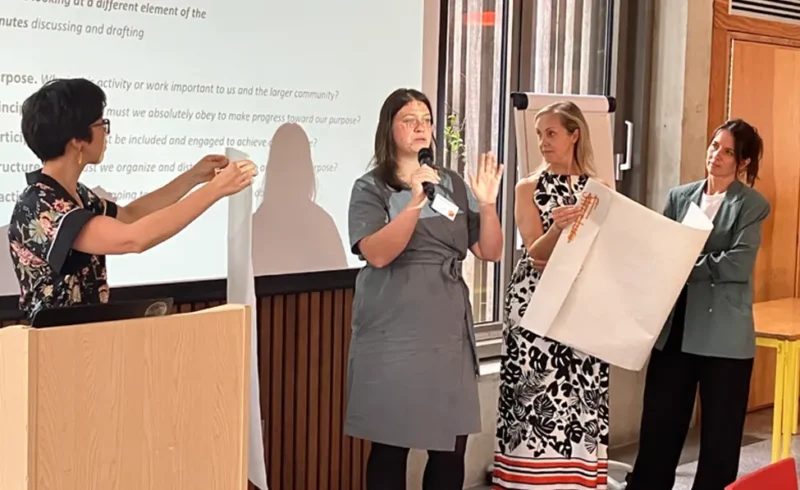
7. Values and Principles for Collaboration
A later table exercise asked: if the aim is to keep the movement coordinated, communicated and delivering research that grows it long-term, what values, purpose, principles, participants, structure and practices should underpin that commitment? Tables worked on different elements; the fullest outputs were on Purpose, Principles and Structure.
Purpose — why joined-up research matters
- Avoiding duplication of effort, and seeing the sector’s development “in the round” as a contribution to a wider movement
- Empowering communities to set the research agenda themselves, and providing better evidence for lobbying
- Generating evidence to challenge the status quo of the current housing system
- Building an evidence base using academic rigour, while staying open to critique and to practitioner input — including genuinely learning from what’s gone wrong, not just what’s worked
- Creating equal status between stakeholders, and forums where they can genuinely work together — including a dedicated space for sharing good practice
- Filling gaps in the evidence on wider value and impact, including community wealth-building
- Building a collective voice for the sector, while still respecting the diversity within CLH
- Valuing practitioners’ and participants’ time, and engaging critically rather than extractively with the sector
- Demonstrating ways to live together through narrative and storytelling, not just data
- Using research to build and demonstrate the sector’s expertise, and to bolster it through difficult periods
- Being as inclusive and affordable as possible, and thinking critically about how CLH’s role plays out in specific local applications
- Creating a genuinely systemic view of the sector, rather than a series of disconnected project-level studies
Principles — the guardrails for progress
- Co-production, working as a non-extractive collective; inclusivity and diversity of perspectives
- Investment, but not at the expense of social purpose; protection of affordability and mission-critical focus
- Long-termism — applied to housing, community and sustainability (climate mitigation and adaptation), “fit for the future”
- “Research & Do” — ensuring practical application and language that’s friendly to practice
- Being locally relevant and place-based, without feeding NIMBYism
- Balancing these principles against developers’ and investors’ perspectives, and welcoming development beyond new-build
- Involving young people, and matching research commitment with tangible outcomes and research ethics for participants
- Clarity of purpose, and making sure commitments made on the day are actually followed through
Structure — how it should be organised long-term
A live debate about which model fits best: a dedicated CLH research centre, a third-sector-style body, or a lighter-touch network/platform
- Whichever model is chosen should be practical and credible rather than purely academic — quantitative, quick, rigorous, able to react to and mobilise around fast-moving issues, and not simply duplicating existing resources or expertise elsewhere
- Questions over who is best placed to hold and secure data, and how neutrality/credibility is maintained — and what role academic partners specifically play in that arrangement
- Not “what” but “how”: the group repeatedly returned to policy support, funding support, and a data observatory/tracking function as the practical building blocks
- A recurring open question: does a CLH centre stay deliberately niche, or does it explicitly embrace the breadth of community-led and collaborative housing?
- Need for longitudinal tracking of benefits, and learning from historic/international examples
- A platform for discourse, research and “do/make” — infrastructure and tools, not just reports
- A framing worth keeping in view: the aim isn’t just a research structure but genuinely changing the debate on housing (echoing, for example, the “housing shouldn’t cost the earth” ecological framing) — asking whose needs the initiative changes something for, socially and politically, and empowering more stakeholders and investors to define what they need from it
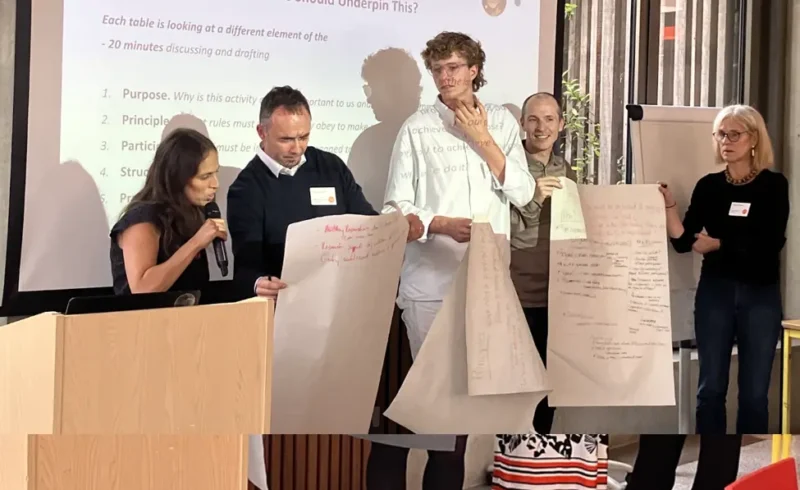
8. Options for Delivery: How Could CLH Research Be Delivered?
Three (non-mutually-exclusive) delivery models were presented and discussed at tables, each with a real-world case study:
1. A Community-Led Housing Research Centre
A funded research institution providing resources for a long-term programme of CLH research — steered by key stakeholders, and acting as a hub and outlet for CLH research. Framed as a vehicle to co-design research priorities, bring dedicated resources, act as a central point to inform policy/practice/funding/finance, and strengthen engagement and evidence-gathering. Discussion drew on the Sheffield example (Dr Tom Archer) as a case study of how such a model has worked in practice.
2. Targeted Research Grant(s)
Dedicated grants to deliver a programme of research responding to specific, sector-identified challenges — co-designed and shaped with the sector, delivering solutions and new thinking on defined problems rather than a standing institution.
3. A Learning Network
A structure for sharing learning and prioritising future research — potentially an annual conference, an ongoing peer network, or a programme of events. Seen as a way to build capacity and deepen co-learning, including opportunities for early-career researchers and industry placements/secondments.
Tables were asked which option would make the most difference, what conditions are needed for it to succeed, and which option people would most want to be personally involved with — noting the options are not mutually exclusive and could be pursued together or in sequence.
9. Key Open Questions for the Co-Founders
Pulling together the comments and tensions raised across the day, these are the open questions worth the co-founders’ explicit attention on Friday:
- Model choice: Is there appetite to commit to a single delivery model (Research Centre, Targeted Grants, Learning Network), or should the group pursue a sequenced/combined approach — and if so, in what order?
- Scope and niche: Should the initiative stay tightly focused (risking being seen as niche) or deliberately broaden to cover the full diversity of CLH models — and who decides?
- Governance and neutrality: Who is best placed to hold data and evidence in a way that all three sectors (practitioners, government, investors) trust? How is genuine, representative community voice ensured, including for people not yet involved in CLH?
- Funding: What is the realistic funding pathway — for the research infrastructure itself, and separately for CLH capital/delivery? How is a mix of public, private and community funding secured and sustained?
- Measuring social value: What shared framework or method will the movement adopt to quantify and communicate social and economic value in terms that satisfy government, investors and communities simultaneously?
- Avoiding duplication and fatigue: What mechanism will stop the initiative flooding practitioners/communities with uncoordinated research requests, and instead pool and readily surface existing evidence?
- Relationship to existing bodies: How does this initiative relate to and strengthen (rather than duplicate) existing organisations — e.g. the housing association sector, the Community Land Trust Network, UK Cohousing Network itself?
- International learning: How far should the group look outside the UK (e.g. Austria’s co-operative housing movement) for replicable models, and who will lead that work?
- Practical next milestone: What does success look like by the time the core team regroups in Leeds on 25 September, and what commitments from today need to be locked in before then?
- Affordability vs. return: How does the movement resolve the recurring tension between protecting affordability/social purpose and the return-on-investment case government and investors need to see?
- Flexibility vs. investability: Can CLH access institutional-scale investment (including by aggregating or linking multiple schemes) without losing the local flexibility that makes it distinctive?
10. Suggested Next Steps
- Core team to regroup in Leeds on 25 September 2026 to review findings from the day and explore funding options, as flagged on the day
- Circulate this report and flipchart photos to all attendees, inviting corrections and additional comments
- Use the individual and paired “commitments and next steps” captured on the day to build a first list of willing contributors and workstream leads
- Begin testing the three delivery models (Research Centre / Targeted Grants / Learning Network) against the funding and governance questions above, rather than treating them as mutually exclusive choices
- Note the follow-up event in Oxford on 29 September as a further opportunity to build momentum
Appendices
Click here to download appendices with links to further information